Thursday, August 27, 2020

The Need for Socialization During COVID-19


      One of the hardest parts of COVID-19 for my own children has been the significant reduction in socialization.  This is not a surprise based upon the limits put on interactions and their own social-emotional developmental stage. Being around peers is normal and healthy part of child development.  At age 5 or 18, kids work to develop a stable self-concept, determine standards for their behavior, learn how the social world works, and develop strategies for self-control through peer interaction. In older adolescents, teens begin to actively separate from their parents. The need to be accepted by friends and belong to a peer group increases starting around age 7 and  prosocial behaviors (such as cooperation, sharing, and empathy) are acquired.  With peers, children and teens learn how to handle conflict, build trust, practice loyalty, and how to support others. Time with other children is a crucial piece of growing up and sadly children and teens have lost many of these opportunities since March.  This has caused some kids and adolescents to act out at home, feel down, or lonely.  This is ok, and should even be expected. (Click here to see Mental Health Red Flags for which parents should stay alert.)

So how can you support your child work through these social developmental milestones while interactions are limited? Deciding between allowing social interaction and protecting from the corona-virus is a balancing act.  It may help to think of social activities on a spectrum of risk to determine what is best for your child and family.  Emily Smith, Assistant Professor of Global Health, Exercise, and Nutrition Sciences at George Washington University’s Milken Institute School of Public Health, suggests considering people, space, place, and time before deciding to meet with others. 

People: Try to keep the total number of people with whom your children interact to a minimum.  This may mean only allowing in-person interaction with a very small number of friends.

Space:  I think we all know that 6 feet apart or more is best. Wearing a mask is advised, especially in situations where 6 feet cannot be guaranteed.

Place:  Outside is better than inside.  Open spaces carries less risk of infection, therefore setting up play dates that involve walks in the park or kickball is better than indoor play.

Time:  Increased time together equals an increase is risk of infection.  Per the CDC, being within 6 feet of a sick person with COVID-19 for a total of 15 minutes counts as a COVID exposure. 

So, now that you know how to lower the risks of exposure- what are activities that have lower risks and could allow your child the chance to interact with their peers? Phone calls and video calls are no risk of infection. The Mayo Clinic suggested that outdoor activities such as walking, running, and biking are low risk.  They also suggest outside games like sidewalk chalk and frisbee (with the use of hand sanitizer) or meet ups for drive-in movies, and picnics (stay 6 ft apart and bring your own food and utensils).

Ultimately, this is a personal decision based upon the health and needs of your family. You must weigh the consequences of a COVID-19 exposure (possible sickness, or quarantine) against the reward for socialization.  There's no easy answer and the struggle is real. If your having trouble deciding, talk about it with someone you trust or try making a pros and cons list.   In the absence of treatment and a vaccine, Bertha Hidalgo, an epidemiologist and associate professor at the University of Alabama at Birmingham’s School of Public Health recommends you proceed with caution and take care to assess risk. “We simply don’t know enough about the virus to be cavalier about returning to before-COVID life. We still need to proceed with caution and do it not only for ourselves, but for others as well,” she says.

**Please reach out to your child's school counselor or try one of these resources if you are worried about the mental health of your child.**


Friday, August 21, 2020

It’s OK not to be OK right now — in fact, it’s normal!


There is something called Toxic Positivity, who knew? I certainly did not but it makes so much sense! Dr. Long defines toxic positivity as the excessive and ineffective overgeneralization of a happy, optimistic state across all situations. The process of toxic positivity results in the denial, minimization, and invalidation of the authentic human emotional experience. “The pressure to appear ‘OK’ invalidates the range of emotions we all experience,” says Carolyn Karoll, a psychotherapist in Baltimore, Maryland. “It can give the impression that you are defective when you feel distress, which can be internalized in a core belief that you are inadequate or weak.”

So how do you deal with Toxic Positivity?

1. Avoid ignoring or stuffing your emotions Acknowledge how you feel, and feel all your emotions, good or bad. Sit with them. Avoiding how you feel will only prolong the discomfort.

2. Listen and validate how others feel — even when it’s different than how you feel Everyone’s entitled to their own feelings. Don’t shame another person for their emotions. It’s really important to acknowledge that others may not cope with things the same way you do.

3. Remember, it’s OK not to be OK “If you’re overwhelmed and exhausted, give yourself permission to rest or do something imperfectly, free of guilt,” Long says.

4. Remember that feelings aren’t mutually exclusive “Healthy positivity acknowledges authentic emotions,” Long says. “It rejects the either/or mindset and holds that two opposing concepts can be true simultaneously. “In other words, you can be sad about losing your job during the pandemic and be hopeful about finding a new job in the future.

5. Be realistic If you want to feel productive, start with small, actionable steps.“Doing things to make you feel better that are extensions of your existing behavioral repertoire requires less cognitive effort and protects the person from setting, and ultimately not meeting, unrealistic expectations,” Zuckerman says.

6. Recognize toxic positivity messages Usually, these messages are overly simple: “Positive vibes only,” “Choose happiness,” etc. Remember, what makes positivity toxic is that it dismisses other genuine emotions, Long explains: “If the message is that positivity is the only or best way to go, that’s problematic.” You don’t have to engage with toxic positivity. See the chart below by Dr. Long that shows a better way of encouraging and supporting someone’s outlook or perception.

Toxic Positivity

Non-Toxic Acceptance & Validation

‘Don’t think about it, stay positive!”

“Describe what you’re feeling, I’m listening”

“Don’t worry, be happy!”

“I see that you’re really stressed, anything I can do?”

“Failure is not an option.”

“Failure is part of growth and success.”

“Positive vibes only!”

“I’m here for you through both good and bad.”

“If I can do it, so can you!”

“Everyone’s story, abilities, limitations are different, and that’s okay.”

“Delete negativity.”

“Suffering is part of life, and you are not alone”

“Look for the silver lining.”

“I’m here for you.”

“Everything happens for a reason”

“Sometimes we can draw the short straw in life. How can I support you during this hard time?”

“It could be worse.”

“That stinks! I am sorry you’re going through this!”


7. It’s OK to be wary of social media “People put their best-filtered foot forward on social media,” Zuckerman explains. “Rarely do people post their faults, flaws, or highlight their poor decision making. As a result, social media gives off the impression that everyone is handling hard times ‘better than you,’ [and] this fosters a sense of loneliness, shame, and embarrassment.” In particular, she adds, watch out for social media influencers, because many promote toxic positivity by only posting their best looks, workouts, and what appears to be perfect lives.

Click either article Healthline and The Psychology Group to read in their entirety.


Thursday, August 13, 2020

Remote Learning Tips for Parents Helping at Home

With Governor Cooper's August 5th announcement of the Phase 2 COVID-19 Extension, it looks as if students will continue remote learning (partial or all day) until at least September 11th.  Even if your child plans to return to campus once we are open for hybrid learning, they will still receive at least half of their instruction on-line.  These tips might help you support your child while they are learning at home. 

  • Provide an Environment Conducive to Learning:  Set your child up in a part of the house that is (mostly) free of distractions and that is easily monitored with little interruption. Try to model a classroom setting as much as possible- dressed for the day, sitting at a table, lights on, electronics (except for school computer) off, toys put away, etc.  Background noise or calming music can often help. Make sure that they have all their learning materials in this place- log in passwords, computer, pencils, post-it notes, paper, notebooks, etc.
  • Set a Learning Schedule: The closer this is to a ‘school schedule,’ the easier it will be on everyone- especially when we moved to hybrid learning. In terms of setting up the schedule students often benefit from starting the day with the most difficult subject and moving on to the ones they like the most. This builds in self- motivation. Of course, this may need to work around any Zoom Meetings scheduled. It may also benefit your child if they can cross completed items off a to do list.  Finally, note that this schedule can revised to fit your circumstance at home (your work schedule, sleeping schedules, etc.). However once you have got something that works, stick to it. 
  • Use a Timer: Let your child decide how much time they need to get an assignment finished (or you make this decision if necessary.)  Remember that children can concentrate on one task for two to five minutes per year old. (So an 8 year old should be able to work for 16-40 minutes.) Then set the timer and let them work independently.  Do not check up on them during this time.  By constantly checking on them, you might send the message that you do not think they can do it on their own. At the end of the timer, go over what they were able to complete.  Celebrate what they accomplished.  If the work is not finished, ask how much more time they might need and reset the timer.  If the child keeps asking for help before the timer is up, you may need to reduce the amount of time for them to work independently.  Also, remember to give them a brain break (1-3 minutes) between subjects.  Do a few jumping jacks, take a walk around the house, or pet the cat or dog before starting the next task.
  • Teach Your Child How To Get Help: Your child's teacher(s) are available to help, but can only assist if they know your child is struggling.  Teach your child how to "raise their hand" and ask for help themselves. Self-advocacy is an important life skill and now is a great time to teach it! Show them how to send their teacher an email through their school account or how to send a message through the Canvas Inbox. Help them make a list of questions to ask during their next Zoom meeting. You job is not to solve all of their problems, but to teach them how to solve problems on their own.
  • Make sure all work is completed: One of the easiest ways to see if there are missing on-line assignments is to utilize the "Grades" page under each course in the Canvas Parent App or through your child's student Canvas account.  It's also a good idea to teach your kids how to check for missing assignments this way.  This provides a running list of all assignments and lets you know which items were turned in and which were not submitted. Please note that these assignments may not sync with PowerSchool and that is ok. Use this as a quick tool to help your child meet deadlines. For any work that remains incomplete ensure that it is incomplete for a good reason and has a time-bound, actionable next-step (e.g., email the teacher asking for clarification).
Please let us know if these tips help.  Also, if you wish to share other ideas that have led to your child's success, please leave them in the comments!  Sharing is caring.

https://www.teachthought.com/technology/remote-learning-tips-for-parents/
https://www.additudemag.com/how-to-focus-adhd-child-homeschool/

Friday, August 7, 2020

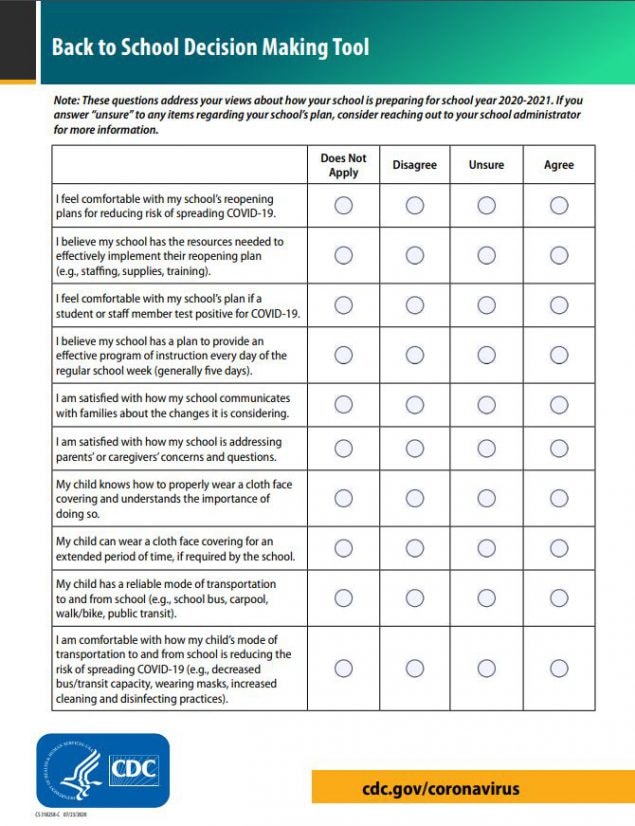
CDC's Decision Making Tool for Deciding How Your Child Goes Back To School

https://www.cdc.gov/coronavirus/2019-ncov/downloads/community/schools-childcare/back-to-school-decision-checklist.pdf

The CDC published a School Decision-Making Tool for Parents, Caregivers, and Guardians that may be helpful (updated July 23, 2020)for deciding if your child should return to campus or stay on remote learning. We all know and agree that school is a vital part of each child’s growth and development. The current world situation makes this decision one that requires some forethought on our part as parents and caregivers. We will be considering many factors, such as individual preferences, health concerns, work situations, and school considerations. When making decisions about school for your family, there are many things to think about beyond academics, such as access to social services and social-emotional support from peers and educators. There are also your personal individual preferences, health concerns, work situations, and school considerations.

As you are making decisions about your child(ren) returning to school, it is important to consider the full spectrum of risks involved in both in-person and virtual learning options. Parents, guardians, and caregivers should weigh the relative health risks of COVID-19 transmission from in-personal instruction against the educational, social-behavioral, and emotional risks of providing no in-person instruction when deciding between these two options. 

We know that certain underlying medical conditions can increase severe illness from COVID-19. Additionally, children who are medically complex, who have neurologic, genetic, metabolic conditions, or who have congenital heart disease might be at increased risk for severe illness from COVID-19, compared to other children. Parents and guardians should consider whether other household members are at increased risk of severe illness from COVID-19 when making decisions about which activities to resume including a child’s return to in-person instruction. If you, your child, or a household member are at increased risk for severe illness from COVID-19, you will need to weigh the benefits, risks, and feasibility of the educational options available.

Aside from a child’s home, no other setting has more influence on a child’s health and well-being than the school. The in-person school environment not only provides educational instruction, but supports a child’s social and emotional skills, safety, speech, mental health, and opportunities for physical activity. The CDC has published a Decision Making Tool to help families with this important task. This tool is designed to help you weigh the risks and benefits of available educational options in making the decision about sending your child back to school.

It is important to take the information learned and compare it to the  UA Return to Campus Guide in making your decision for your family. Please take a moment to read the article in its entirety here. No matter how you decide, Union Academy is committed to serving your child(ren).

Friday, May 29, 2020

Breathing to the Rescue!

JUST BREATHE brush calligraphy banner
image found here


We all know that breathing is a required action to stay alive, but did you know it can be important HOW you breathe? Scientific America published an article explaining how the sympathetic and parasympathetic systems react to our breathing which directly impacts your mood. 
      
Everyone knows that emotions affect the body. When you are happy, for instance, the corners of your mouth turn up automatically, and the edges of your eyes crinkle in a characteristic expression. Similarly, when you are feeling calm and safe, at rest, or engaged in a pleasant social exchange, your breathing slows and deepens. You are under the influence of the parasympathetic nervous system, which produces a relaxing effect. Conversely, when you are feeling frightened, in pain, or tense and uncomfortable, your breathing speeds up and becomes shallower. The sympathetic nervous system, which is responsible for the body’s various reactions to stress, is now activated. Less well known is that the effects also occur in the opposite direction: the state of the body affects emotions. Studies show that when your face smiles, your brain reacts in kind—you experience more pleasant emotions. Breathing, in particular, has a special power over the mind.
     
When should I do this? The best time to apply slow-breathing techniques? One is during occasional episodes of stress—for example, before taking an exam or competing in a sporting event.  Practice the techniques with regularity during the day, during breaks, or at moments of transition between two activities: you simply stop to adjust your posture and allow yourself a few minutes of quiet breathing. Practice them as part of your sleep routine to help with insomnia and improve the quality of sleep
    
 What breathing techniques are they talking about? Two commonly known are:
-   “365 method”: at least three times a day, breathe at a rhythm of six cycles per minute (five seconds inhaling, five seconds exhaling) for five minutes. And do it every day, 365 days a year. 
-   Box Breathing: 1 slowly exhale to empty your lungs 2 Inhale slowly and deeply through your nose to the count of four. In this step, count to four very slowly in your head. Feel the air fill your lungs, one section at a time until your lungs are completely full and the air moves into your abdomen. 3 Hold your breath for another slow count of four. 4 Exhale through your mouth for the same slow count of four, expelling the air from your lungs and abdomen. Be conscious of the feeling of the air leaving your lungs. 5 Hold your breath for the same slow count of four before repeating this process. Here is the entire article including a guided video for Box Breathing.  
- Here are 10 more breathing techniques including how each affects your physiology and how to do them. 
    
 Why again is how I am breathing so important? Slow-breathing techniques may help manage chronic anxiety and insomnia when practiced regularly. Breathing exercises also help to counter the accumulation of minor physical tension associated with stress. Some studies even suggest that in addition to providing immediate relief, regular breathing exercises can make permanent changes in the brain circuits defending your body against stress and improve your immune system. 

Need to contact your School Counselor for more ideas? You can find our contact information to the right=>

Monday, May 18, 2020

A Conversation to Parents about How Uncertainty Affects our Brain Function by Becky Bailey

I am a person who thrives on information. I find comfort in the knowing, and this new situation has added anxiety for me because there is simply so much unknown. Becky Baily is the founder of Conscious Discipline and did a webinar about how the 'unknown' affects our brain function and chemistry. She also talks about children and how 'unknown' affects their brains differently than our own as adults and ways to help them.

The Conscious Discipline site is offering many free opportunities for parent and educator learning through June 30th. This is an amazing resource and even more amazing that it is free right now. Some of the resources include 4 Tips for Successful Home Learning,  Responding to Disruptive Smaller Children at Home, Answering Children's Difficult Questions and so much more. I encourage you to take the opportunity to see what resource(s) may be offered that fit your family.

Please reach out to your School Counselor if you need additional support. You can find our contact information to the right of this blog.

Thursday, May 14, 2020

6 Ways to Help Your Child Manage Their Anxiety During COVID-19 By American Psychological Association

           
image from ptaourchildren.org
     We are all feeling the stress of the changes to our 'normal'. Anyone who says they are not being affected is not being truthful. This statement goes for our children too; both young and old. We can do our best to shield them from the ongoing Pandemic, but the change in how we live our daily life can be missed by no one. Our Parent Book Study this week on 'Parenting with Love and Logic' made this observation even more clear. There was a lot of discussion around talking with our children no matter their age. The children that seem to be handling it best, may actually be the ones who most need this talk. 
      If you missed the first session, please join us next week on Tuesday at 8pm. You can sign up here. Also great news!  If you missed registering for the course, or know someone who might benefit from learning the Love and Logic parenting method, they have extended their offer for the Free Parenting Course.  Interested individuals now have until May 15th to register. Click this link to register for the course. (On May 16th it returns to regular price- $99.) 

The American Psychological Association has these 6 suggestions for parents: 

1. Remain calm and reassuring
Your children are watching you, even the smallest of babies can feel and see your reactions. They will take cues for how to respond directly from what they see you do. Be aware of your behaviors and think about how your reactions may influence your child
2. Be open and honest
Even though you may fear that talking to your child about the pandemic will increase their worries, bringing difficult topics into a conversation can actually help to quiet stressors, as children can imagine scenarios far worse than reality. Sharing factual and age-appropriate information will help them put the situation into perspective.
3. Keep a routine
Research suggests that children benefit from schedules and productive activities, so plan activities that will create structure and fun memories. Research has also found that spending time in nature has multiple positive effects on children’s physical and mental health. So it would be good for the whole family to spend time outside by taking a walk or riding bikes in the neighborhood. You can reread Your Friend the Daily Schedule from an earlier post by Mrs. Brun for more suggestions.
4. Managing Screen Time
In this unprecedented time, extra screen time during the next few weeks won’t hurt children. Flexibility is important, so don’t feel guilty about relaxing the rules. However, this doesn’t mean unlimited screen time. Caregivers should strive for a balance between digital and non-digital activities. For example, if a child spends time on a digital learning activity in the morning, they should take a break for a creative endeavor—like painting or baking cookies—or play a board game with the entire family. Parents should also monitor their own digital device use. Developing these habits now will continue to help children after this extended period at home and away from school. You can reread Managing Screen Time During the Pandemic from an earlier post by Mrs. Brun. 
5. Practice self-care and stay connected
With an increase in responsibilities and caretaking duties, you need to take care of yourself. Remember, you are modeling for your kids how to handle stressful situations. When you take care of yourself, you are teaching your children this is an important foundation for successful daily living. 
6. Behaviors during stress
When children and teens are stressed, their behaviors may change. Don’t be surprised if your children exhibit mood swings and problems with attention and concentration. This is the time to give your child extra patience and support. You may notice behaviors in children that may be cause for concern, such as your child making physical complaints. They may say they don’t feel well or have a headache, which may be their way of expressing their worry or concern. If you or your child feels overwhelmed, it may be time to talk to a licensed mental health professional. 
The APA has published information about resources:
Finding local mental health resources during the COVID-19 crisis
More help to manage anxiety: For additional information on how to manage anxiety and resources on COVID-19, visit APA’s website. For additional local resources. Please reach out to your School Counselor as a resource as well. You can find our contact information to the right of this blog.